Gumroad is one of the simplest places to start selling a digital product: upload a file, set a price, share a link. Its pricing is simple too, but simple is not the same as cheap, and the fee you pay depends on how the buyer found you. This explainer sets out Gumroad's fees as its own pricing page states them, works through what they mean at three price points, and lists what to compare before you decide where to sell. Every figure below is from Gumroad's own pages, with the date each was read. For the side-by-side with other platforms, see selling fees compared and Gumroad alternatives.
Gumroad's fees, from its pricing page
Gumroad's pricing page, read on 5 November 2026, states two rates:
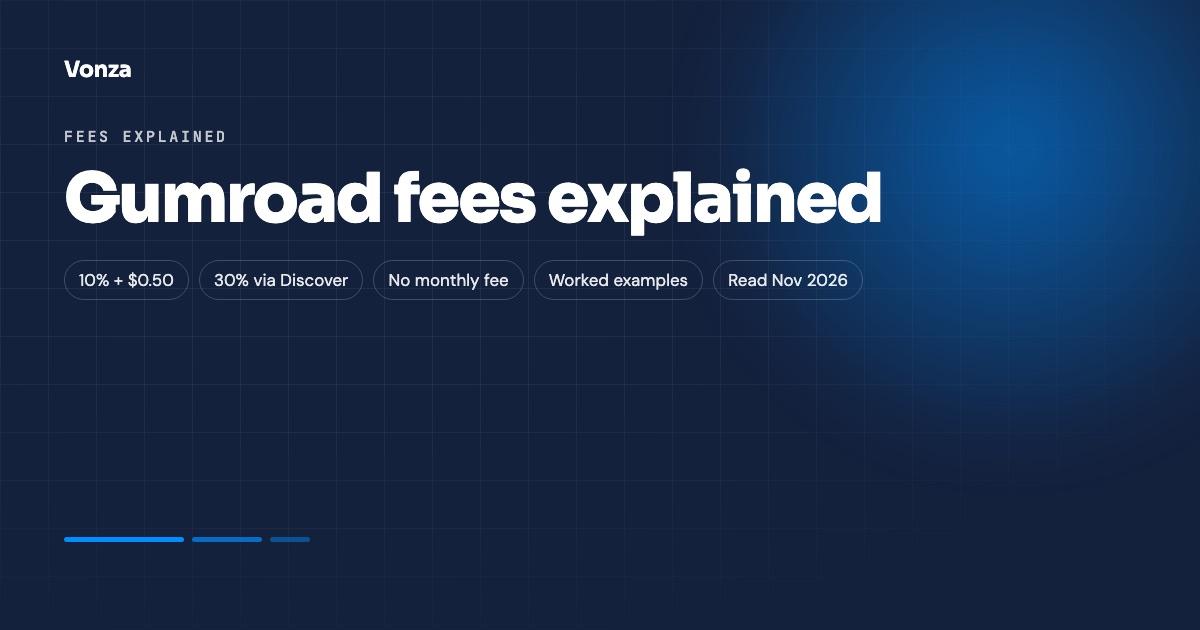
- 10% + $0.50 per transaction "for all sales through your profile or direct links to your customers".
- 30% per transaction "when new customers find and buy from you through our discover marketplace".
The same page says there are "no hidden fees, no monthly charges", and in its FAQ that "Gumroad doesn't charge you a monthly fee. Instead, our fees are deducted as a small percentage of every sale".
Two other points from the page matter for the total cost of selling there. Gumroad says that since 1 January 2025 it is the merchant of record and "handles ALL your tax obligations", collecting and remitting sales tax worldwide; that is part of what the percentage buys. And on getting paid, the page says how creators are paid, "whether through direct deposit or PayPal, varies by country".
What the page does not state is a separate payment-processing fee; the two rates above are presented as the fees. We quote only what is on the page.
The two rates in practice
The difference between 10% + $0.50 and 30% is the difference between a sale you brought and a sale Gumroad brought. A buyer who clicks the link in your newsletter, your bio or your video description is a direct sale. A buyer who was browsing Gumroad's Discover marketplace and found you there is a Discover sale.
That is a reasonable deal when Discover brings you buyers you would never have reached. It is an expensive one when a buyer who already knew you happens to search inside Gumroad instead of clicking your link, because the same sale now costs three times as much. Sellers who rely on Gumroad tend to work hard at sending traffic to their direct links for exactly this reason.
Worked examples at three prices
These are arithmetic from the two rates on Gumroad's pricing page read on 5 November 2026. They leave out anything the page does not state.
A $5 product
- Direct sale: 10% is $0.50, plus $0.50, so $1.00 in fees. You keep $4.00, which is 80%.
- Discover sale: 30% is $1.50. You keep $3.50.
At low prices the fixed $0.50 bites hardest: on a $5 item the direct fee is effectively 20%.
A $20 product
- Direct sale: $2.00 plus $0.50, so $2.50. You keep $17.50, which is 87.5%.
- Discover sale: $6.00. You keep $14.00.
A $100 product
- Direct sale: $10.00 plus $0.50, so $10.50. You keep $89.50.
- Discover sale: $30.00. You keep $70.00.
A month of sales
Say you sell 100 units of a $20 product, 80 of them through your own links and 20 through Discover. Direct fees: 80 × $2.50 = $200. Discover fees: 20 × $6.00 = $120. Total $320 on $2,000 of sales, which is 16% of revenue. Change the mix to 50/50 and the total becomes 50 × $2.50 + 50 × $6.00 = $425, or 21%.
Run your own numbers with your own prices and your own guess at the Discover share. The share is the figure that moves the total most.
What Gumroad's percentage buys
Fees are only half of a comparison; the other half is what you get for them. From Gumroad's own features page, read on 14 November 2026, the platform offers a page editor to build a storefront, a custom domain for it, an embeddable payment button, memberships and subscriptions ("monthly, quarterly, biannually, yearly, and more"), pay-what-you-want pricing, multiple currencies, generated licence keys for software, multiple file versions (such as PDF, ePub and Mobi), lightweight DRM, email broadcasts and automated workflows, and analytics. Its pricing FAQ says it sells "digital products, e-books, courses, tutorials, and memberships".
Being merchant of record is the feature most sellers underrate. Gumroad takes on the tax collection and remittance for every sale, which for a solo seller shipping digital files worldwide is a real job avoided.
Percentage fee or subscription: how to compare
The honest way to compare Gumroad with a subscription platform is to total a month, not a sale.
- Estimate your monthly sales: units and average price.
- Estimate your Discover share. If you do not know, assume a small one; most of your buyers come from you.
- Work out Gumroad's monthly fees from the two rates above.
- Put that figure beside the monthly price of the subscription platforms you are considering, plus whatever payment-processing fees apply there, which are the processor's own rates and not the platform's.
A percentage fee is cheapest when sales are small and irregular, because a month with no sales costs nothing. A subscription is cheapest once monthly sales are steady and large, because the fee stops growing. Where the two cross depends entirely on your numbers; at $2,000 a month in the example above, Gumroad's fees were $320 to $425.
Beyond price, compare what you need to sell. If your products are a mix of downloads, physical goods, services and gift cards, or you also sell courses, run email campaigns and build funnels, the platform that holds all of it is worth more than the one with the lowest fee on a file.
How Vonza is priced
Vonza is a subscription that includes an online store alongside courses, email, funnels, forms, scheduling and a link in bio; the plans and what each includes are on pricing, and every plan comes with a 14-day free trial. Buyers pay through your own connected Stripe or PayPal account, with PayPal for one-time payments, or Paystack for sales in Nigerian naira, so the payment processing is the processor's and the money lands in your own account. The store sells digital downloads, physical goods, services, bundles, gift cards, licence keys and links, with a cart, a choice of checkout layouts, order bumps and one-click offers, and private expiring download links for files. See sell digital products for the detail, Vonza vs Gumroad for the head-to-head, and Shopify vs Gumroad and Gumroad vs Payhip for how Gumroad compares with two other common choices.
Where to start
If you sell on Gumroad today, pull last month's sales report and split it into direct and Discover; the two rates above give you the real cost of the month in two minutes. Then compare that figure with the platforms in selling fees compared, each priced from its own page on a stated date, and with our dated guide to the best platforms to sell digital products. For Payhip's and Etsy's fees in the same format, read Payhip fees explained and Etsy fees for digital products.