
You can start an online store without inventory in four ways: sell digital products (courses, ebooks, templates) that have no stock at all, dropship physical products that a supplier ships for you, use print on demand so each item is made after it is ordered, or sell services such as coaching. In each case you only pay for the product, or deliver it, once a customer has ordered.
This guide compares the four models and walks through the steps to launch.
Four ways to sell without inventory
| Model | What you sell | Who delivers | Main trade-off |
|---|---|---|---|
| Digital products | Courses, ebooks, templates, downloads | Delivered online, instantly | You have to create the product first |
| Dropshipping | Physical products from a supplier | The supplier ships to the buyer | Thin margins, little quality control |
| Print on demand | Your designs on shirts, mugs, posters | A print partner makes and ships each order | Higher cost per item |
| Services | Coaching, consulting, done-for-you work | You do | Your time is the limit |
Digital products
The simplest store without inventory sells information and creative work: an online course, an ebook, templates, printables or music. There is nothing to store or ship, and each extra sale costs almost nothing. See 15 digital products you can create and sell for ideas.
Dropshipping
You list a supplier's products in your store. When a buyer orders and pays you, you pass the order to the supplier, who ships it directly to the buyer. You never touch the product.
To make money dropshipping:
- Choose products with enough margin to cover the supplier's price, shipping, payment fees, ads and returns. Low-priced items rarely leave enough.
- Source as close to the maker as you can. A manufacturer usually charges less than a wholesaler.
- Order samples first, so you know the quality and the real delivery time.
- Write your own product descriptions with the words buyers search for, rather than copying the supplier's.
Print on demand
A print partner puts your designs on products only after a customer orders, then ships them. It suits artists, creators and communities selling merchandise.
Services
Coaching sessions, audits, design work and consulting need no stock: the buyer pays online and you deliver the work.
How to start, step by step
1. Do your market research
Find a niche you can serve and a product people already look for. Free keyword tools, marketplaces and social media show what people search for and buy. Check what competitors charge and what their reviews complain about.
2. Register your business
Register the business where you live, plan how you will file your taxes, and set up a business address and contact details. Buyers trust a store more when they can see who runs it and how to reach them.

3. Plan shipping and fulfilment (physical products)
Decide who ships and who checks quality:
- The supplier ships directly to the buyer. The least work, but little quality control: if the supplier keeps shipping defective items, you lose customers.
- The supplier ships to you, and you forward orders in your own packaging. Full quality control, more work, and you hold some stock.
- A third-party logistics company stores, packs and ships for you, and can inspect goods before they go out.
Show delivery times and shipping costs clearly on every product page.
4. Create your products
For digital products, build the course, ebook or download. For physical products, list each one with photos, a clear description, sizes and options, the price and the delivery time.
5. Set up your online store and payments
Your online store lists the products, takes payment and confirms each order. Connect a payment processor so buyers can pay by card and other methods they trust.
6. Answer questions quickly
Reply to questions and complaints fast. Slow replies cost sales and lead to returns, especially for a product that suddenly sells well.
Selling without inventory on Vonza
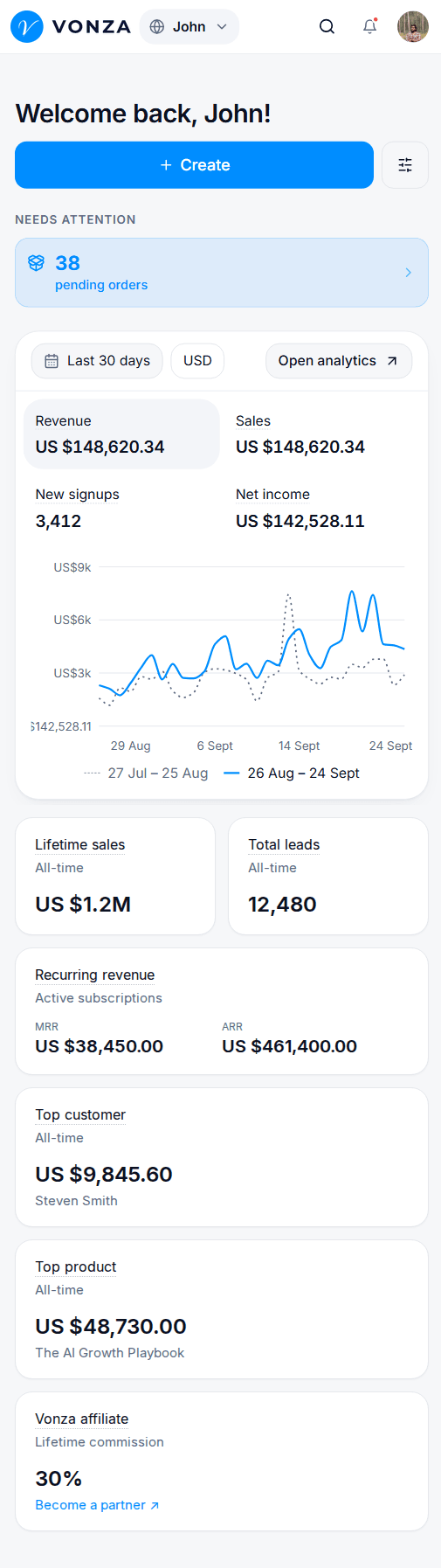
A Vonza store sells physical and digital products. Digital products are delivered as a download link right after payment, physical products can have shipping zones, and payments go through your own connected Stripe or PayPal account, or through Paystack for sales in Nigerian naira. Vonza has no dropshipping supplier integration, so for dropshipped or print-on-demand items you pass each order to your supplier yourself.
Many sellers without inventory build around digital products and services instead: a Vonza checkout can sell a course, a membership, a bundle or a community, or just the page for a service you deliver yourself, with order bumps and a one-click offer after payment.
Conclusion
Digital products are the easiest way to start an online store without inventory: no stock, no shipping and high margins. Dropshipping and print on demand let you sell physical products without buying stock first, if you watch your margins and your suppliers' quality. You can try Vonza with a 14-day free trial; see pricing.