An affiliate program turns the people who already like your course into a sales team you pay only when it works. A past student recommends the course in their newsletter, a podcaster mentions it to their listeners, a peer in your niche shares it with their audience, and each of them earns a commission when someone buys through their link.
This guide walks through building one for an online course, from the commission to the first payout, and ends with how to run it inside Vonza's affiliate program.
Why course creators run affiliate programs
- You pay for results, not for attention. With ads you pay for clicks whether or not anyone buys. With affiliates you pay a commission when a sale is made.
- You know the cost of each sale in advance. You set the commission before anyone promotes, so you know what every referred sale costs you.
- The traffic comes with trust. An affiliate's audience already listens to them. A recommendation from someone they follow carries more weight than an ad.
- You choose who represents you. You decide who to invite, what they can promote and what they agree to before they start.
- Your marketing does not depend on one channel. Affiliates promote through newsletters, YouTube, podcasts, communities and blogs, so one platform changing its rules does not stop your sales.
An affiliate program works best once your sales page already converts. Affiliates send warm visitors; if the page does not sell to them, the affiliates stop promoting.
Step 1: Decide what affiliates can promote
Start narrow. Most creators open the program on their flagship course first, then add other products once it runs smoothly. Decide:
- Which products are in the program: one course, every course, or also your membership, community or coaching.
- Whether every affiliate can promote everything, or only the products you give them access to.
Step 2: Set the commission
You have two shapes to choose from:
- A percentage of the sale. The most common choice for courses. It scales with your price, so you never have to update it when you raise prices.
- A fixed amount per sale. Easier to explain ("earn $50 per sale"), and useful when you sell the same course at several prices.
Then decide whether affiliates also earn on the later payments of a payment plan or subscription, or on the first payment only. Recurring commission is a strong reason for an affiliate to promote a membership.
For how to pick the actual rate, see what commission to offer affiliates for an online course.
Step 3: Choose the cookie window and attribution
When someone clicks an affiliate's link, a cookie remembers that affiliate for a set number of days. If the visitor buys within that window, the affiliate earns the commission.
- Window length. Match it to how long your buyers take to decide. A low-priced course is often bought the same day; a premium programme may take weeks. Vendors set different defaults: Kajabi lets you choose 30, 60 or 90 days, Podia defaults to 15 days and allows 1 to 90, and ClickFunnels uses 45 days (all read 25 November 2026).
- First or last click. If a buyer clicks two affiliates' links, decide who gets the credit: the first affiliate who introduced them, or the last one who sent them to buy. Teachable and LearnWorlds credit the last click and Podia credits the first (read 25 November 2026). First click rewards the affiliates who start the conversation; last click rewards the ones who close it.
Step 4: Decide when commissions are paid
Never pay a commission before your refund window has passed. A hold period protects you from paying on a sale that is later refunded. Kajabi recommends at least 30 days before a commission becomes due, and ClickFunnels uses a 30-day cooling-off period (both read 25 November 2026).
Then decide:
- A minimum payout, so you are not sending tiny transfers.
- A payout schedule, such as monthly or twice a month.
- What happens on a refund after payment. The fair rule is that a refunded sale's commission comes off the affiliate's next payout.
Step 5: Write short terms
Affiliates should know the rules before they start. Cover:
- the commission, the cookie window and the hold period,
- when and how they are paid, and the minimum payout,
- where they may promote (for example, no bidding on your course name in search ads, no spam),
- that commissions on refunded or fraudulent orders are not paid,
- that you can remove an affiliate who breaks the terms.
Keep it to one page. Long terms do not get read.
Step 6: Recruit your first affiliates
The best first affiliates are usually already close to you:
- Happy students. They can describe the result from experience. Invite the ones who finished the course or left good feedback.
- Peers in your niche with an audience that overlaps yours but a different offer.
- Newsletter writers, podcasters and YouTubers who already talk about your topic.
- Communities where your ideal students gather, through their owners or moderators.
Start with a handful of people you invite personally. A small group you talk to often will sell more than a long list of strangers.
Step 7: Give affiliates what they need to promote
Make promotion easy. Prepare:
- Their link, and a short link or QR code for talks and live sessions.
- Swipe copy: a ready-made email, a few social posts and a one-paragraph description of the course.
- Banners and social images in the sizes they will use.
- The key facts: who the course is for, the result, the price and any launch dates or bonuses.
Then keep in touch. A short monthly email with what is coming up, and a thank-you to the affiliates who made sales, keeps the program alive.
Step 8: Track, pay and review
Each month, check which affiliates send clicks and which send sales, pay on schedule, and look at the commission you are paying against the revenue it brings. Talk to your top affiliates: they will tell you what makes your course easy or hard to promote.
Who moves the money: how course platforms compare
The biggest practical difference between course platforms with built-in affiliates is who actually pays the affiliate. From each vendor's own help pages, read on 25 November 2026:
| Platform | How affiliates are paid |
|---|---|
| LearnWorlds | Commissions are calculated, but "payouts must be handled externally" |
| Podia | You pay affiliates through PayPal or outside Podia, then mark them paid |
| Kajabi | You pay outside Kajabi, or automatically from your own PayPal Business account |
| ClickFunnels | You mark payouts as paid, or pay one at a time through PayPal |
| systeme.io | Monthly payout invoices that you pay through PayPal or Wise |
| Stan | Stan pays affiliates automatically |
If you pay affiliates yourself, plan the time for it each month.
How to run your course affiliate program on Vonza
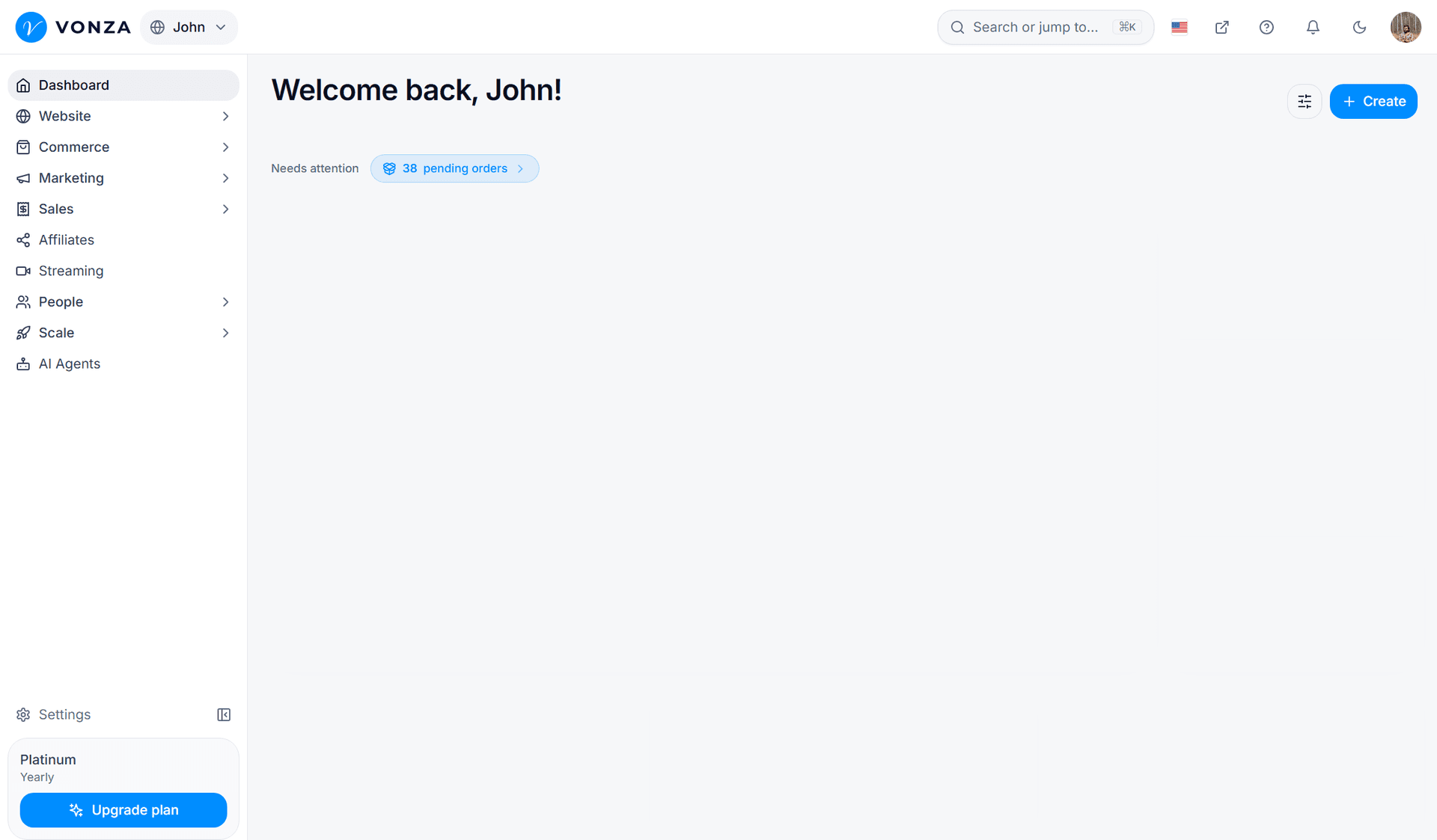
Vonza's affiliate program is built into the platform you already sell on, so there is no separate affiliate tool to connect. Here is how each step above works in Vonza.
What affiliates can promote. Courses, communities, products, forms, bookings, degree programmes, funnels, and whole sites or landing pages. You let affiliates promote everything, or only the products you choose, and you can switch promotion off for any single product.
Commission. A percentage of the sale or a fixed amount per sale, set for the whole program, for one product, or for one affiliate on one product. A new program starts at 15% with a 30-day cookie until you change them. Recurring commission is a switch per product and per affiliate, off by default: when it is on, affiliates earn on the later payments of instalment plans and subscriptions that Vonza charges, as long as the first payment earned a commission that was not refunded.
Cookie and attribution. You set the cookie length and choose whether the first or the last affiliate link wins. Tracking works in the browser the visitor clicked in, so the sale counts when they buy in that same browser.
Which sales earn commission. Commissions are earned on sales paid by card through Stripe. Sales paid through PayPal, or in naira through Paystack, do not earn affiliate commission. If most of your students pay in naira, plan for that before you launch.
Hold, approval and payouts. A commission waits 30 days, which covers your refund window, and is then approved automatically. Affiliates connect a Stripe account to be paid by direct deposit. You review and send payouts yourself, or let Vonza pay approved commissions on a schedule you choose (monthly, twice a month or weekly) once an affiliate passes your minimum payout. PayPal is not offered as a payout method for new affiliates. If a sale is refunded before its commission is paid, the commission is cancelled; if it was already paid, the amount comes off the affiliate's next payout.
Joining. Share your affiliate sign-up link, or invite people by email and choose which products each one can promote. There is no approval step: anyone who registers through the sign-up link becomes an affiliate straight away, so share that link only where you are happy to take everyone, and invite people by email when you want to choose. You can block or remove an affiliate at any time.
Terms. Write your terms in Vonza or upload them as a PDF. Affiliates see them in their area.
Promo materials and the affiliate area. Affiliates sign in to an area on your own site with their links, QR codes, a UTM link builder, the banners, swipe copy, social cards and email templates you upload, and their clicks, sales and earnings, with a CSV export. You can email your affiliates from Vonza and see your top affiliates on a leaderboard.
What it does not do. There are no two-tier commissions (affiliates do not earn on affiliates they recruit), and there is no automatic check for affiliates buying through their own link.
The pricing page shows which plans include affiliates, and Vonza starts with a 14-day free trial, so you can set up your program on a real course before you decide. If you want to earn by recommending Vonza itself rather than your own course, that is Vonza's separate partner program, at partners.vonza.com.