A paid community earns money in one of a few ways: members pay to get in (a subscription, a one-time fee or installments), they pay for more inside (paid spaces, linked courses and products), or other people pay you because of the community (affiliates and sponsors). The hard part is not choosing a model. It is keeping members long enough for any model to add up. This guide covers the ways to earn, the math to check before you set a price, and what keeps people paying month after month.
If you want the platform side first, the paid community platform page shows how plans, spaces and checkout work on Vonza.
What makes people pay for a community
People do not pay for "access to a group". They pay for a result they cannot get as easily alone, and for the people who help them get it. Before you pick a price, write one sentence that finishes "Members join to…": to ship their first product, to pass an exam, to grow a church small group, to stay accountable to a training plan.
That sentence decides almost everything else:
- What goes behind the paywall. Live sessions, feedback on work, a course, templates, a hot-seat call, a space with the founder.
- Who it is for. A community for "anyone interested in fitness" is hard to charge for. A community for "runners training for a first marathon" is easy to explain.
- Why someone stays. A one-off goal suits a one-time fee or a fixed number of payments. An ongoing practice suits a subscription.
Ways to earn from a community
Most communities that last use two or three of these, not all of them.
1. Memberships
A subscription charged every week, month or year until the member cancels. It gives you predictable income and gives members a simple reason to judge value each month. On Vonza this is the Subscription Plan. If you want a fixed run instead (say six monthly payments for a six-month program, then stop), use a Recurring Payment plan.
Offer a yearly option beside the monthly one. Members who commit for a year leave less often, and the yearly plan gives you cash up front.
2. Tiers through paid spaces
Instead of building separate communities for each tier, keep one community and charge for some of its spaces. Spaces are the main areas of a Vonza community (rooms are channels inside them), and a space can be public, private, paid or read-only. A space can have its own plans, and a community plan can also unlock chosen spaces, so a higher plan can include the "Inner circle" or "Office hours" space while the base plan does not.
This keeps everyone in one place, lets members see what the next tier contains, and makes upgrading a single step. Members can upgrade straight away (prorated) or move down at renewal from their own settings.
3. One-time access
A single payment for access that lasts forever or for a set time (Vonza lets you set access in days or months). This suits a community tied to a book, a challenge or a course launch, where members want the group for a defined stretch.
4. Installments
An Installment Plan splits a larger price into scheduled payments (up to 100, the same amount or custom amounts), with the first taken at checkout. A Flexible Payment plan takes an optional first amount at checkout and lets members pay the rest of the total later. Both make a premium community or a mastermind affordable without lowering the price.
5. Pay what you want
A Pay What You Want plan lets members choose the amount, with an optional minimum and maximum. It works well for supporter-funded and faith communities, and as a way to test what members value the community at.
6. Linked courses and products
Courses, digital products and bundles can be linked to the whole community or to a single space. Content can be Open, so members are enrolled automatically, or Locked, shown to members who enroll in it separately. Members see linked content in a Classroom grouped by space. This lets you bundle a course into a higher plan, or sell it to members who already trust you.
If you sell courses too, how to price your course covers the course side.
7. Affiliates
Two kinds help here. A community affiliate program pays your members and partners a commission for bringing in new paying members: on Vonza you set a percentage of the sale or a fixed amount, choose whether it recurs, and invite affiliates. See the affiliate program page. Separately, you can recommend tools and services your members already need and earn their affiliate commissions, as long as you disclose it and only recommend what you use.
8. Sponsors, coaching and events outside the paywall
A focused community is an audience brands and partners will pay to reach, and some members will want one-to-one help. Sponsorships, paid coaching and in-person events are worth adding once the core membership works, not before.
The pricing math to check first
Before you set a price, do the arithmetic. These figures are hypothetical examples to show the calculation, not results anyone has reported:
| Paying members | Monthly price | Monthly revenue before fees |
|---|---|---|
| 50 | $30 | $1,500 |
| 100 | $20 | $2,000 |
| 250 | $15 | $3,750 |
| 400 | $25 | $10,000 |
The formula is paying members × price = revenue per period, before payment processing fees and before members who leave. Two more lines of arithmetic matter more than the table:
- Churn. If 100 members pay $20 and 8 leave each month, you need 8 new paying members every month just to stand still. Halve the churn and the same marketing grows the community.
- Mix. Suppose 100 members, 70 on a $20 monthly plan and 30 on a $200 yearly plan. That is $1,400 a month plus $6,000 collected up front each year. The yearly members also cannot drift away in month two.
Work backwards from the income you need: divide it by the price you are comfortable charging, and ask whether that number of members is realistic for your audience. If not, change the offer, not just the price. The community pricing strategy guide goes through setting the number.
Retention: why members stay
A paid community lives or dies on the second and third month. These four habits do most of the work.
Trials that end in a habit
A free trial (1 to 365 days on subscription and installment plans on Vonza) lowers the risk of joining, but a trial only converts if the member does something in it. Plan the first week of a trial member's life: one post to make, one event to attend, one piece of content to finish.
Onboarding in the first week
New members decide quickly whether they belong. Give them a "Start here" space, a pinned welcome post that says what to do first, and an introductions thread. If you use approval, ask two or three membership questions so you can welcome people by name and point them to the right space. Vonza's community templates include a "Start here" space in the Coaching layout and an Introductions space in the Local club layout. A posting rhythm such as "Intro Monday, Question Wednesday, Win Friday" gives new members an easy first step.
Events members plan around
A recurring event is a reason to renew. A weekly Q&A, a monthly workshop or a co-working hour gives members a date in their calendar. On Vonza members RSVP, add the event to their calendar and get email reminders before it starts. See community events.
Recognition
People stay where they are noticed. Reply to first posts, feature member wins, and make progress visible. Points, levels and a leaderboard reward the members who show up, and ranks mark time in the community. See community gamification.
Measure it
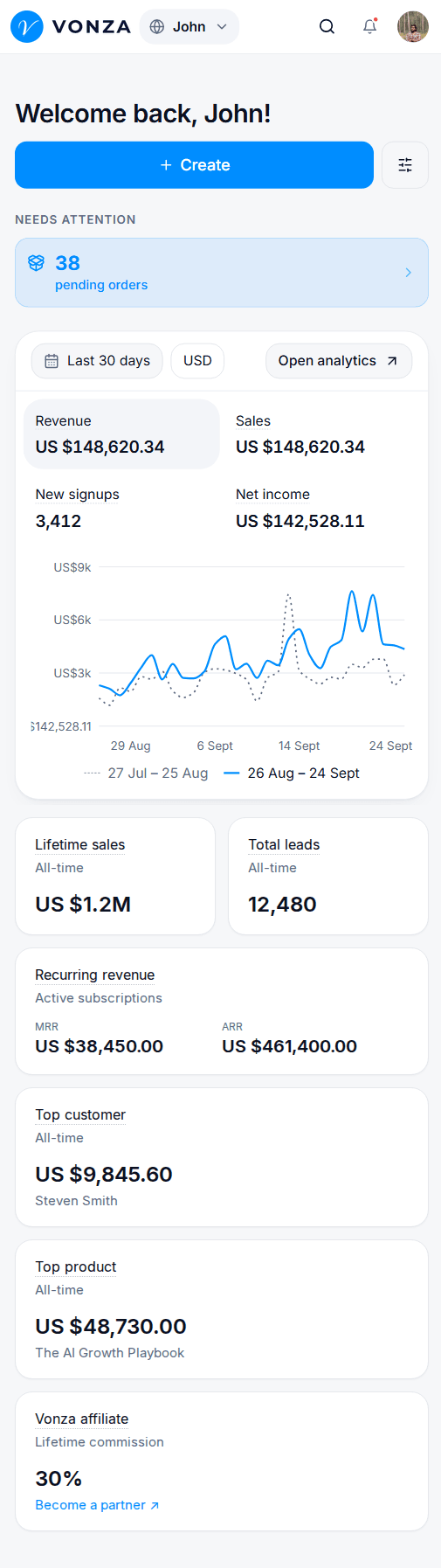
Watch subscription churn, active members and which spaces get used. Vonza's community analytics show revenue, MRR, subscription churn, member churn and retention month by month, so you can see whether a change to onboarding or events actually kept people.
Growing the paying member base
Retention keeps members; you still need new ones. What works for most communities:
- A clear promise on the sales page. Say who it is for, what happens inside each week and what it costs at checkout.
- A free way in. A free space, a free event or a free plan lets people try the community before they pay.
- Your email list. Invite your existing audience first; they already know you. Vonza sends email invites ten at a time or enrolls up to 100 people directly.
- Members who invite members. Members can share an invite link by copy, email or WhatsApp. An affiliate program turns your best members into a referral channel.
- Partners. Co-host an event or a challenge with a community that serves the same people.
If your community currently lives in a Facebook group or a Discord server, moving it to a paid home is often the first step to charging for it.
Where to start
Pick one way to earn, write the "Members join to…" sentence, do the math with your own numbers, and plan the first week for a new member before you launch. Then add a second income line once members are staying. The best community platform page shows how Vonza puts the community, payments, courses and events in one place on your own site and brand.